Between the Fringe
Tommy A. Caruso Sr.
The headache started behind Tommy's left eye a little after three and stayed there the rest of the day like a nail being worked through green wood.
By dinner he had already been four different men.
On the first call, he was translator, walking his boss through a piece of technology that could change how their engineers worked. On the second, he was teacher, sitting with a young analyst whose dashboards were collapsing under load, asking questions until the kid found the answer himself. On the third, he was husband and homeowner, standing in his own kitchen with a contractor talking estimates for a house they had not even closed on yet, nodding at numbers while his wife ran late getting their daughter home from treatment.
On the fourth, he was alone.
That room was the garage. The forge was cold. The reloading press was covered. Garden tools hung in a row on the wall, arranged during one of his restless Saturdays when his hands needed a problem his heart could not name. He reached for the light switch and his back seized deep in the hinges, not sharp, not sudden, just the old pain in the load-bearing places.
He left the light on.
Upstairs, the house settled around his family. His wife was putting their daughter to bed. Three days home from the hospital and still carrying that pale, frayed look of someone recently pulled back from the edge. Tommy knew that edge from the inside. That was the part that frightened him. He knew its weather. He knew how lies could come dressed as conclusions.
He went back inside and made his rounds without thinking. Check the back door. Pick up the cup on the counter. Adjust the thermostat. Straighten the shoes near the mudroom bench. Small acts no one asked for. No one noticed. That was fine. If you were doing watchkeeping right, the people inside the perimeter slept through it.
In the living room, he lowered himself into the chair by the window and put on music low enough not to wake anyone. Jim Croce. Harry Chapin. Gordon Lightfoot. James Taylor. Men who sang like they knew time was always slipping one finger at a time through a closed fist.
The first song was "Operator."
Tommy closed his eyes.
The list came at once. Old house to sell. New house to close. Fiscal year plan. Engineers who needed clarity. A boss he was shielding from operational noise because the man had to grow into a bigger role and Tommy knew how to hold a line quietly. His daughter upstairs. His own body. Physical therapy starting this week. Steroids for inflammation. Strength training he kept putting off because there was always something more urgent than his own back, his own lungs, his own sleep.
There was always something more urgent than his own body.
He reached for the can of nicotine salt packets on the side table, thumb working the lid without opening it. For one second he wanted a real cigarette instead. Something lit. Something with an ember on it. Something old and ugly and honest.
He set the can back down unopened.
Harry Chapin came on. His daughter was upstairs. His wife was upstairs. His brother was dead three years now and still found ways to sit down in every quiet room in the house. Tommy had always thought grief would shrink if he outworked it long enough. Instead it had learned the floor plan.
He leaned back and let the ache in his spine spread where it wanted.
He was tired.
Not sleepy. Not dull. This was the kind of tiredness that settled below thought. The kind that came from carrying so long that carrying had become the shape of the self. Rest felt like dereliction. Stillness felt like exposure. An empty minute felt like the cut in the soundtrack before something terrible entered the frame.
James Taylor came on.
Something in his back let go, not enough to feel better, just enough to tell him how hard he had been clenching for how long. His breathing changed with it. The room seemed to thin.
He opened his eyes.
Nothing had changed.
Then his body moved before his mind did.
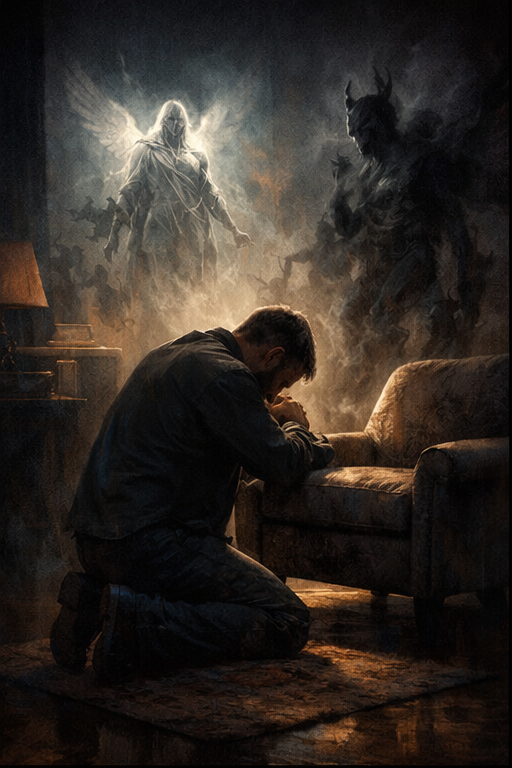
One moment he was in the chair. The next he was kneeling beside it with both hands on the cushion and his forehead resting against his knuckles.
He stayed there, breathing.
No polished prayer came. Just the old human sounds of a man whose body had run out before his duties had.
Above him, the house was quiet. Wife asleep or nearly. Daughter asleep or pretending.
The HVAC kicked on.
And the room opened.
The rush in the vents deepened into something vast and martial, as if wind were moving through ranks of standards in a country too old for maps. The darkness in the corners did not deepen. It became occupied.
Then the question came, simple as a blade.
Am I good?
Not strong enough. Not useful enough. Not faithful enough.
Good.
The moment the question touched the room, the unseen war answered.
The living room did not vanish. It was overlaid. Behind the drywall, Tommy sensed height without ceiling. The corners became towers. The hallway stretched into a narrow causeway. The windows turned black and reflective, no longer glass but sealed gates under assault. The family pictures on the shelf held fast like icons in a chapel taking artillery.
And all around the house, beyond sight but not beyond knowing, the armies moved.
One movement above the roofline, descending in ordered force, bright and terrible, like ranks wheeling into position under command.
Another movement lower, closer to the ground, spreading through the neighborhood and the trees and the dark seams between homes, patient for cracks.
The war had been there all along.
Tonight he could see between the fringe.
Tommy had felt presences before.
At seven, under blankets in the dark after his grandfather died, when something young and wild-haired had stood in the room where nothing should have stood and a weight had settled on his chest, not crushing, only present.
At seventeen, on a back road outside Charleston with a huge stranger in his passenger seat telling him to drive, while Tommy talked to him like a friend because he did not know what else to do and somehow came away alive with nothing missing but a handful of quarters.
At eighteen, after the truck wreck, after pulling Eli clear, after being marked dead, when he stood somewhere in an emergency room from a place that had no floor and watched a doctor stitch up a body he knew was his.
At hospice with Pete, when a dying man woke clear-eyed and asked when they were going to blow the joint and Tommy, with his dirty hands and unordained mouth, told him the truth and then prayed because no man should walk to that edge alone.
The seam had never fully closed after that wreck. He had always known it.
Now it tore wider.
And in the tearing he understood the shape of the battle.
Not a war for his life.
A war for his consent.
The pressure came hard then, no longer subtle.
It rolled through the room in organized accusation, not one voice but a host speaking with a single intention. The dark beyond the windows flexed. Shapes moved in it, tall and bent, carrying standards stitched from vows gone rotten. Their faces kept changing. A dead brother. A younger version of himself. A daughter upstairs. A boss needing translation. Every burden he had ever named, wearing flesh just long enough to wound.
And farther back in the black, something vast watched and waited.
The pressure struck him with knowledge.
Charleston first.
A boy in a CRX with the wrong door unlocked, a Marine in the passenger seat, death in the back roads, a clearing in the woods, other men waiting.
What saved you?
Not mercy.
Usefulness.
The vision snapped and changed.
The truck wreck.
Metal screaming. Glass. Blood. Eli half out of the cab. Tommy dragging him clear. Tommy collapsing.
What brought you back?
Not love.
Need.
The vision changed again.
Pete in hospice. Truth and prayer at the edge of death.
Why did you matter in that room?
Because you had something to give.
The blows kept coming. Every engineer who needed him. Every child who watched him. Every room he had steadied. Every hand he had held. The accusations braided themselves into a single chain and wrapped it around his chest.
You are what you carry.
The unseen host beyond the windows pressed closer.
Take the name.
Tommy understood the offer immediately.
Bearer. Necessary Man. The One Who Must Earn His Place.
Accept it and everything simplifies. Every scar gains explanation. Every exhaustion becomes identity. Every fear becomes duty in better clothes.
Accept it and despair becomes clean.
The dark host surged.
The house shuddered.
Upstairs, a floorboard creaked as if something had put weight on it from the wrong side.
Tommy's hand shot toward the can of nicotine salt packets.
A truce. A numbing. A way not to hear.
His fingers touched the lid.
And the other side moved.
The ordered force above the roofline descended in full.
No feathers. No singing.
War.
Light hit the house from directions the earth did not contain. Lines of force slammed into the dark around it. The black standards outside the windows snapped backward as if caught in a blast wave. The hallway behind Tommy elongated into something like a stone corridor lit by impossible fire. Along it stood ranks of bright ones, armored in obedience, faces severe with joy. Some held the line at the roof. Some stood at the doors. Some ringed the sleeping rooms upstairs with drawn light like swords too pure for metal.
And among them, two presences came nearest.
One arrived as perimeter.
Not a form Tommy could fully hold, only command made tangible. Iron certainty. The keeper of gates. The one who had been with him in every instant where courage had to outrun fear. Tommy felt that presence plant itself at the boundary of the house and the whole structure answered, studs and bolts and brick and beam, as if remembering its first design.
The other came closer.
Not weaker. Never weaker.
Closer.
It knelt where Tommy knelt. Not beside the man he was now, but somehow beside the boy under the armor, the child under blankets in the dark, the son under the uniform, the man under the roles. Its nearness did not remove pain. It made pain tell the truth.
The dark host reeled, then regrouped.
Take the name, they pressed.
Their standards changed again. Now they were made of memories. Charleston. The truck. Pete. Coralie. Norma breathing in the next room. The years. The promises.
Take the name and keep them safe.
That hit hardest.
Because that was the hook.
Not pride.
Love.
Take the chain and call it service. Take self-erasure and call it husband, father, leader, son.
The host outside the house advanced one more step.
Above, the bright ranks held.
Then the nearer presence spoke, not in sound but in recognition so clean it split him.
You were loved before you ever made yourself useful.
Tommy sucked air through his teeth.
The dark answered instantly.
Useful kept you alive.
Then the other presence at the perimeter made itself known without words, and with it came memory in right order.
Seven years old under blankets.
Beloved.
Seventeen on a dark road.
Beloved.
Eighteen in a room with no floor.
Beloved.
Before the oath. Before the uniform. Before the first rescue. Before the first room he learned to save by entering it.
Beloved.
The word did not soothe.
It detonated.
The dark host faltered as if struck by something older than war. The standards outside the windows blackened at the edges.
Tommy's hand came off the nicotine can.
The pressure redoubled, now venomous.
Then stop carrying and see what remains.
Your daughter upstairs remains unguarded if you stop. Your wife remains uncared for if you stop. Your people remain leaderless if you stop.
Take the name. Wear the burden. Become the altar.
Tommy's whole body shook.
This was not about relief.
It was about worship.
The lie wanted him to kneel to burden itself. To sanctify exhaustion. To mistake the chain for a crown.
Around the house the war reached its fiercest point. The dark struck the perimeter in waves. Bright ranks met them. Tommy could not follow the full geometry of it. Only flashes. Spears of white force. Banners splitting. The sound of impact like bells dropped into deep water. The neighborhood hid under an instant of revealed conflict, every sleeping house with its own watch, every threshold contested.
This was happening everywhere.
But it was happening here.
Now.
For him.
For his will.
Tommy lowered his head until it almost touched the chair.
The pain in his back was incandescent. The headache flared. Upstairs the house gave another soft settling groan. It sounded heartbreakingly ordinary against the war.
And in that crossing of ordinary and eternal, he understood what was being asked.
Not to become strong. Not to become worthy. Not to become fluent in holy language.
To choose.
To trust what had claimed him before his usefulness ever did.
Tommy drew breath.
"I belong to God," he said, and his voice was raw enough to sound torn. "Paid for already. You do not get to name me."
The sentence hit the room like law.
The dark host broke.
Not all at once. Not forever.
But enough.
The nearest standards outside the windows burst into black ash and came apart on a wind that blew the wrong direction. The bent shapes recoiled. The pressure in the walls collapsed inward and fled through seams too small to see. Whatever vast intelligence had watched from farther back withdrew a single measure, not defeated, but denied.
And the bright ranks answered.
They did not cheer.
They advanced one step.
That was worse for the enemy than celebration.
The perimeter sealed.
The house became a house again.
The hallway shortened. The windows became windows. The family photos became family photos. The music returned as a phone speaker playing softly in a living room after midnight.
Tommy remained on his knees another minute, breathing hard, forehead against the chair, his whole body trembling with the aftermath.
The two presences did not leave.
One kept watch.
One stayed near.
Neither demanded anything more.
At last he rose carefully, one hand on the chair, like a man learning his own body again after battle. The room looked ordinary, but not innocent.
He went into the kitchen and filled a glass with water. His hand shook. He drank half of it standing at the sink, looking out into the dark yard.
Only his own reflection stared back.
Tired. Hurt. Alive.
Not healed.
Aligned.
That was the word.
The floor held under him, not because he held it up, but because it had always been there.
He rinsed the glass and set it down. He checked the locks once more, but now it felt less like compulsion than stewardship. The perimeter was worth tending. That was different from believing he was the perimeter.
He climbed the stairs.
At his daughter's door he stopped and watched her sleeping shape rise and fall under the blanket. He did not think of being an example. He did not think of winning her war for her. He only stood there as her father, grateful for breath, aware now of the bright line drawn at her threshold by hands not his own.
In his room, his wife shifted in her sleep and reached for him without waking, her hand finding his forearm as if she had always known exactly where he would be. He sat on the edge of the bed and let that simple contact mean what it meant. Not labor owed. Not another invoice from love. Just love recognizing its own in the dark.
When he lay down, the pain was still there.
So was the list.
So was the grief.
But the lie had lost its right to name him.
On the edge of sleep, he felt the watch continuing without him. One presence still at the boundary. One still near the child under the armor.
Outside, the night leaned hard against the world and found doors barred, lamps lit, swords drawn.
Inside, under an old and undeserved mercy, Tommy finally unclenched.
He was a soldier. A husband. A father. A leader. A brother. A son.
He was an oath-keeper.
He was wounded.
He was beloved.
And for this one dark night, that had been enough to call armies.
He slept.